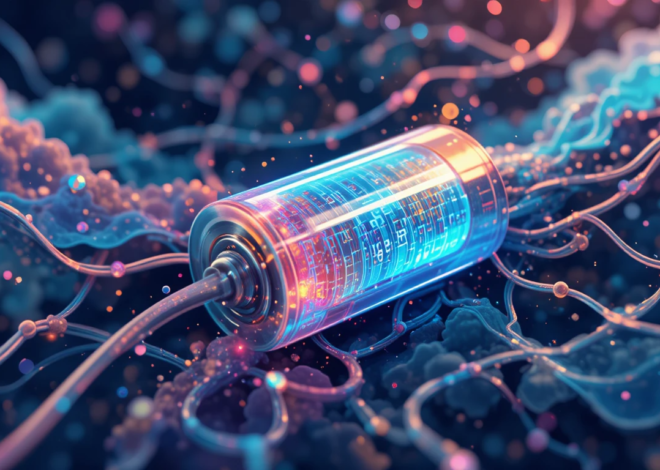

Cambridge Scientists Make LEDs From Materials That Don’t Conduct Electricity
GOOD NEWS IN ONE SENTENCE Cambridge University scientists discovered how to electrically power materials that normally don’t conduct electricity, creating ultra-pure near-infrared LEDs that could revolutionize deep-tissue medical imaging and high-speed data transmission.
WHY THIS MATTERS Some of the best light-emitting materials for medical imaging can’t be integrated into electronic devices because they don’t conduct electricity. Doctors need near-infrared light that penetrates deep into tissue for diagnostics, but traditional LEDs can’t produce light pure enough for precision work. This breakthrough makes the previously impossible possible, creating a entirely new class of devices for applications we haven’t even imagined yet.
THE STORY
When Insulators Become Emitters
Lanthanide-doped nanoparticles have long frustrated engineers. These materials produce exceptionally pure, stable light perfect for penetrating biological tissue. They emit in the second near-infrared region, which passes through skin and organs with minimal scattering. For medical imaging, they’re nearly ideal.
Except for one problem: they’re electrical insulators. You can’t plug them in and turn them on.
Researchers at Cambridge’s Cavendish Laboratory, led by Dr. Zhongzheng Yu and Dr. Yunzhou Deng, found an elegant solution. They attached carefully chosen organic molecules to the nanoparticles that act like tiny antennas, harvesting electrical energy and transferring it to the insulating material.
Published in the journal Nature, their work demonstrates the first light-emitting diodes built entirely from materials that don’t conduct electricity under normal circumstances.
Molecular Antennas Do the Work
The organic molecules trap charge carriers and efficiently harvest “dark” molecular triplet excitons, a specific type of excited state that’s usually difficult to capture. These molecular antennas then channel that energy into the lanthanide-doped nanoparticles, causing them to emit their characteristic ultra-pure light.
The system operates at relatively low voltages around 5 volts. The emitted light has an extremely narrow spectral width, making it much purer than competing technologies like quantum dots.
Dr. Yu emphasizes the advantage for biomedical applications and optical communications. For sensing or transmitting data, ultra-specific wavelengths eliminate interference and increase precision. The devices can perform tasks that current technologies simply can’t match.
A New Class of Devices
The team achieved peak external quantum efficiency above 0.6 percent for their near-infrared LEDs. For first-generation devices built from electrically powered insulating nanoparticles, the performance exceeded expectations. The researchers have already identified clear pathways to enhance efficiency in future designs.
Dr. Deng calls it the beginning of something much bigger. The fundamental principle is so versatile that countless combinations of organic molecules and insulating nanomaterials can now be explored, creating devices with tailored properties for applications not yet conceived.
BY THE NUMBERS
- 5 volts operating voltage
- 0.6%+ external quantum efficiency
- First-in-class electrically powered insulating nanoparticles
- Second near-infrared emission for deep tissue penetration
- Spectral purity exceeds quantum dots
- Published in Nature journal
- Supported by UK Research and Innovation grants
WHAT’S NEXT
The research team continues improving efficiency and exploring new combinations of organic antennas with different insulating materials. Early applications will likely focus on specialized medical diagnostics where ultra-pure near-infrared light enables imaging previously impossible. Optical communication systems requiring precise wavelengths for high-speed data transmission represent another promising avenue.
THE HEART OF IT: Science advances when someone figures out how to do what everyone said was impossible. Electrical insulators don’t conduct. That’s their defining characteristic. Yet these Cambridge researchers found a way to make them emit light on command by giving them molecular helpers to handle the electrical work. It’s the kind of lateral thinking that opens entirely new technological frontiers. Medical imaging that sees deeper with greater clarity, optical communications that transmit faster with fewer errors, sensors that detect with unprecedented precision. None of these applications existed yesterday because the devices to enable them couldn’t exist. Now they can. Sometimes the biggest breakthroughs come not from making existing technology better but from making impossible technology possible.
SOURCE https://www.sciencedaily.com/releases/2025/12/251205054734.htm
OPTIMISM RATING ⭐⭐⭐⭐ (4/5)
Share this content: